Pharmacy First
Pharmacy First and NHS prescribing
Pharmacy First Explained
Community pharmacies across Leicester, Leicestershire and Rutland (LLR) can help with common illnesses and urgent repeat medicines. This page explains how patients can access these NHS services and what pharmacy teams and GP practices need to know about the October 2026 changes.
Service update | 29 October 2026
NHS England published a revised specification for Pharmacy First. The changes enable independent prescribing at approved pharmacies and update requirements that also apply to teams delivering the existing services. Prescribing availability varies by pharmacy. Check with your pharmacy before travelling if you need a prescribing consultation.
Pharmacy First
Watch our Pharmacy First introduction
Watch Pharmacy First explained
| Part of the service | How patients access it |
| Clinical pathways for seven common conditions | Contact a participating pharmacy directly or access the service through an eligible NHS referral. |
| Urgent repeat medicine supply | An eligible NHS referral, for example from NHS 111, allows a pharmacist to assess whether an emergency supply is appropriate. |
| Minor illness consultations | An eligible NHS service, such as a GP practice or NHS 111, can refer patients for assessment, advice and treatment where appropriate. |
The seven original pathways cover. Each pathway has its own eligibility criteria. Distance-selling pharmacies do not provide the acute otitis media pathway.

View the NHS England Pharmacy First specification and clinical pathways
* Distance Selling Pharmacies do not complete consultations for Acute Otitis Media.
These pathways include structured clinical protocols and the supply of specific POMs under PGDs, improving access and reducing GP pressures.
Pharmacy First strengthens the role of community pharmacy as the first contact point for healthcare, expanding the scope of services and enabling pharmacists to deliver faster, high-quality care directly to patients.
What independent prescribing adds
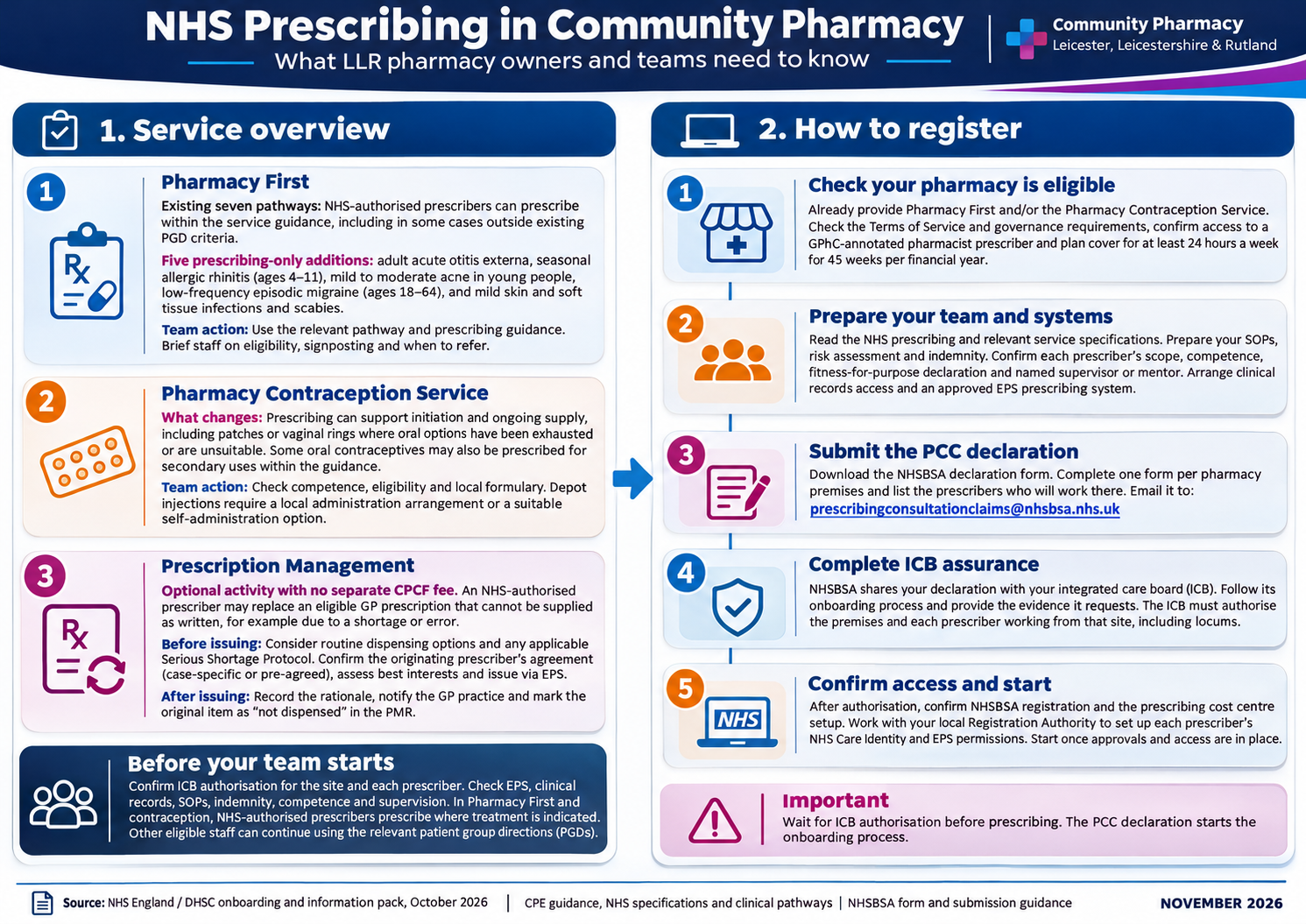
At an approved site, an NHS-authorised pharmacist independent prescriber can prescribe within the seven existing clinical pathways and provide five additional prescribing pathways:
- Low-frequency episodic migraine in adults
- Seasonal allergic rhinitis in children
- Acute otitis externa (outer ear infection) in adults
- Mild to moderate acne
- Mild skin and soft tissue infections and scabies
Skin and soft tissue infections and scabies have separate pathway documents. Check the relevant pathway for age limits, eligibility, exclusions and consultation requirements.
When an NHS-authorised prescriber at an approved site provides a Pharmacy First clinical pathway consultation and a medicine is indicated, they use the prescribing route. Other appropriately trained professionals can continue to deliver the elements they are authorised to provide under the relevant patient group directions (PGDs). The prescribing extension is limited to the specified clinical pathways, alongside the separate prescription management arrangements below.
Read the NHS England prescribing specification and clinical guidance
Prescription management
When an NHS prescription issued by a GP practice is presented for dispensing and cannot be supplied as written, an NHS-authorised pharmacist prescriber at an approved prescribing pharmacy may be able to issue a replacement prescription. This could help when there is a supply problem or an issue with the original prescription.
The replacement requires agreement from the original prescriber or GP practice. This can be a case-specific agreement or an arrangement agreed in advance for defined circumstances. The pharmacist prescriber assesses whether the replacement is in the patient’s best interests, documents the consultation at the time, sends the outcome securely to the GP practice and marks the original item as not dispensed in the pharmacy record. The patient can choose where the replacement prescription is dispensed.
Prescription management is optional and carries no separate payment under the Community Pharmacy Contractual Framework. Pharmacy teams and GP practices considering it should agree how they will authorise replacements, exchange information and reconcile the original item.
Read NHS England’s prescription management guidance
What LLR pharmacy teams need to do
If you already provide Pharmacy First
- Read the revised specification and brief your team. Review standard operating procedures, business continuity plans, training and equipment checks, consultation arrangements and record keeping.
- Review referral and urgent supply procedures. Pharmacy First now restricts pharmacy owners from creating referrals on behalf of patients except in the exceptional circumstances set out in the specification. The expanded urgent supply section restates the existing legal requirements for emergency supplies.
- Check your governance and claims processes. Review how your team accesses patient records, communicates outcomes, manages conflicts of interest and retains evidence for post-payment verification. Pharmacy First teams can also access NEWS2 e-learning.
If you plan to add NHS prescribing
- Review the prescribing specification with your prescribers. Check your service readiness, clinical supervision, indemnity, risk assessment, patient record access, prescribing IT and arrangements for communicating with GP practices.
- Complete the NHSBSA sign-up and ICB onboarding process. Start only once the site and individual prescribers are authorised and the ICB has confirmed your go-live date.
- Agree local arrangements with GP practices. Confirm referral routes, how urgent queries will be escalated and how consultation outcomes will be shared. Agree any prescription management arrangements before using them.
CPE guidance on prescribing, sign-up, IT and claiming
Local resources for pharmacy teams and GP practices
- Pharmacy First resources for LLR pharmacies
- Pharmacy First resources for GP practices
- LLR Pharmacy First updates for 2026/27
- Contact Community Pharmacy LLR for local implementation support.
- Pharmacy Support Resources
- Implementation & Checklists
- GP Practice and Reception Team Support Resources
- Multifactor Authentication (for Locum Pharmacists)
- PharmRefer
- CPE National Resources